

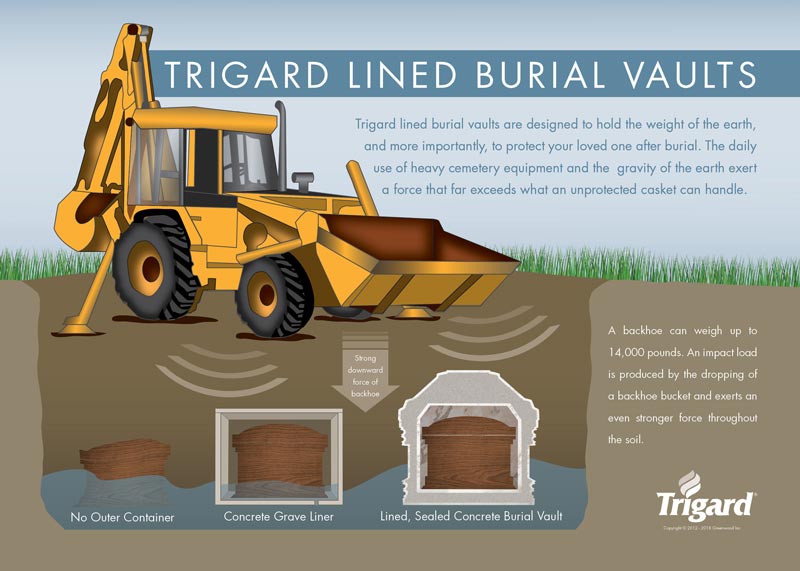
Burial vaults are not required by law in the United States. However, most cemeteries do require a burial vault—or at minimum, a grave liner—to protect the casket from the weight of the soil above it and to prevent the burial space from collapsing.
While burial vaults are a common requirement, many families are unsure of what a burial vault is and why it matters. Essentially, a vault provides an added layer of protection for both a loved one’s remains and the cemetery grounds.
What Is a Vault?
A vault is also commonly known as a grave vault, burial liner, or burial vault. No matter what you call it, this sturdy receptacle serves as a protective container for the casket. When they were first developed, vaults were typically made out of brick or wood.
Today, burial vaults can be made of many materials including metal and plastic, but they are more likely to be made out of concrete which works better at preventing both the casket and the grave from sinking into the soil once buried.
A true burial vault will enclose the casket on the top, bottom and all four sides. Often, the casket is lowered into the vault and then the vault is sealed using a strong butyl tape seal, and then the entire unit is lowered into the ground. Afterward, a lid is added to seal the vault and begin its process of protection.
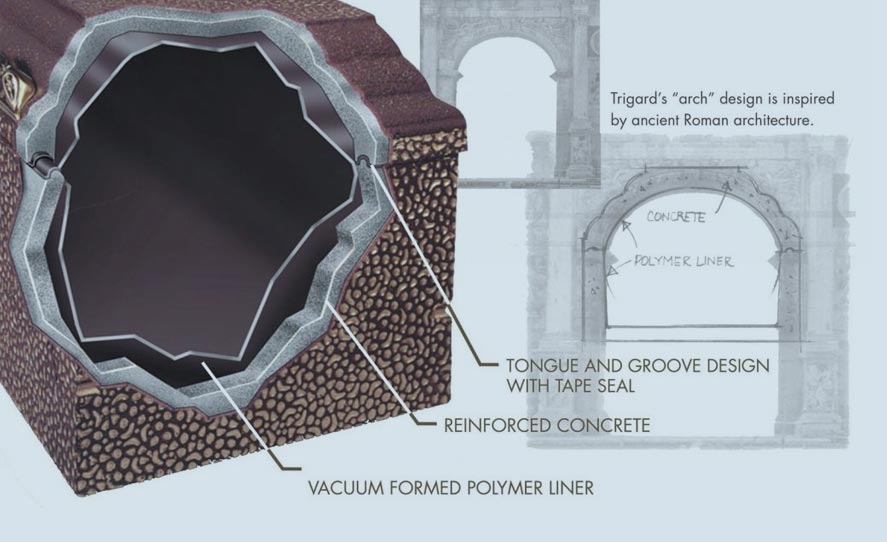
Some vaults are poured as a base with four sides and a lid that seals to that base. Other vaults use the four sides and top as a full-coverage lid, which is then placed on top of the base to create a tight seal.
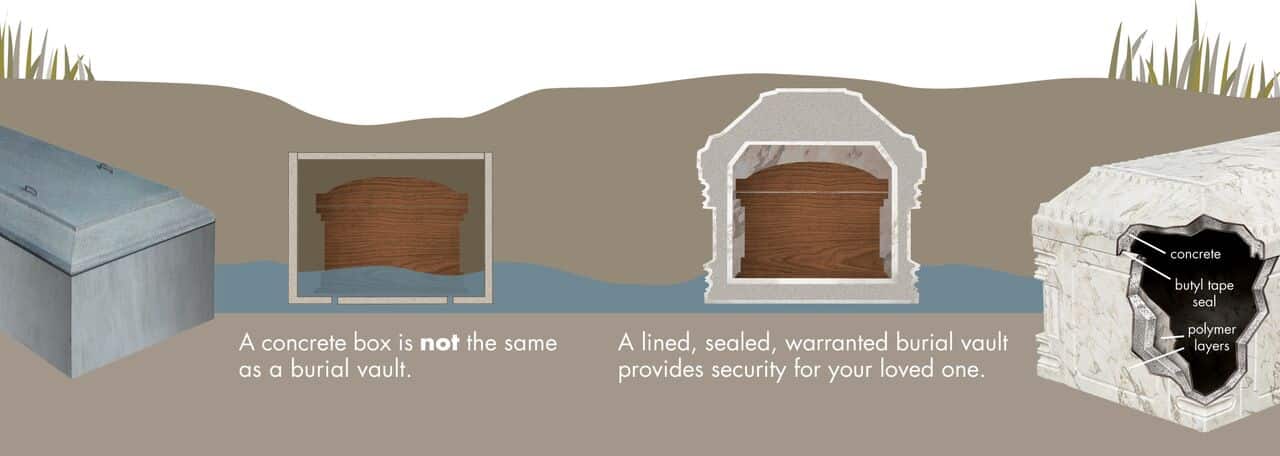
A grave liner is similar to a vault, but a grave liner may not have a bottom. Instead, it gets lowered into the grave after the casket is placed within it. Grave liners can also be made with bottoms on the bases, but they will contain holes allowing water to rise and fall within the container.
Before you choose the right burial option for your needs, it is important to determine your budget. There are many different options that affect the price of a burial vault. There are different personalization options you can choose from as some options are aesthetic, and some add protection. You can also pick from various materials, warranties, and protection levels.
A grave liner will typically be a less expensive option, but a burial vault is generally more effective over the long-term. They are superior at preventing degradation, collapse, and other unfortunate instances.
Why Put a Casket in a Burial Vault?
Using a burial vault for a casket is a technique that has been used for over 100 years. While there were most likely uses of the burial vault before this time, its use wasn’t officially documented until the late 1800s. Since its inception, this design has become a standard practice in many parts of the country.
While vaults are now a part of burial traditions, many people are curious about why we even use them. Do you really need to put a casket in a vault for burial?
Whether they are required by a cemetery or not, there are two main reasons why you may want to invest in a burial vault. When you use a vault, it can protect the cemetery’s ground around your loved one’s gravesite as well as the casket and the remains of the deceased.

Protection of the Cemetery
The entire purpose of a burial vault is to protect the casket. Otherwise, the casket would gradually start to decay and breakdown into the earth. The weight of the earth above the casket and any heavy equipment at the cemetery like excavators and lawn movers could eventually cause the soil to sink and the casket to cave in, leaving the cemetery’s ground unlevel and unsafe.
Because of the safety risk, many cemeteries require families to buy a receptacle for the casket. At the very least, cemeteries will expect the use of a grave liner with some holes in it.
Getting a lined, sealed burial vault is also important for other reasons. This kind of vault helps support the earth’s weight while preventing outside elements from getting into the casket’s space. A burial vault is one way cemeteries can protect visitors from uneven grounds and other potential dangers.
Protection of the Casket Space
A lined, sealed burial vault protects the inside of the vault from outside elements. These elements include things like dirt, water, and even insects.
When a casket is sealed in a burial vault, it has an added layer of protection for many years to come. The casket is less likely to deteriorate as it is safer from outside elements.
Designing a Final Resting Place for Your Loved One
Making decisions about which burial vault to use can be overwhelming as you plan out your loved one’s final resting place. If you need help selecting the right burial vault, our staff members can guide you through the entire process and make it much easier. Please feel free to give us a call at (800) 637-1992 or find a dealer to assist you!
FAQ
Here are some frequently asked questions about burial vaults.
When did vaults become required for burial?
Burial vaults started being required by most cemeteries in the early to mid 1900s. The invention of a fully enclosed, sealable vault in 1912 marked a shift toward the durable vaults used today. Although not always required, burial vaults have been used since the 1700s, originally as a safeguard against grave robbers. The history and evolution of burial vaults span centuries, reflecting changing needs and traditions.
What are the NCBVA standards for burial vaults?
The National Concrete Burial Vault Association (NCBVA) defines a concrete burial vault as a lined and sealed burial receptacle. It is constructed using materials designed to increase strength (minimum 5,000 PSI) and reduce the risk of intrusion from exterior elements.
Can burial vaults be customized for unique cultural or personal preferences?
Burial vaults have evolved to offer a wide range of distinctive options. These customizations include varying levels of protection using combinations of plastic, concrete, and metal. Bronze, copper, and stainless steel interior liners and accents can also be added to enhance the vault’s aesthetics. For a truly personal touch, graphic appliqués featuring photo collages may be affixed to the exterior of the vault.
Trigard’s Healing Tree®️ burial features memory rings scattered across the vault cover, which can be incorporated into the graveside ceremony. Following the reading of a special poem, attendees are instructed to say their goodbyes as they take a keepsake ring to keep as a permanent memento.
What are the different types of burial vaults that Trigard offers?
Trigard offers a variety of vaults designed with unique features to meet the diverse aesthetic preferences and protection needs of today’s families. These vaults range from the highest levels of durability and elegance to customized designs that reflect personal or cultural significance. Below, you will find an overview of our product line.
Elite®️: Known as the strongest and most beautiful vault in the industry, the Elite features a handcrafted metal interior and matching cover. It offers ultimate protection and is customizable in a variety of colors and metal choices.
Reflection®️: This vault combines excellent durability with an elegant luster. It is texturized and hand-painted to reflect light. Available in stainless steel, copper, and bronze, it allows for endless customization options.
Aegean®️: Popular for its aesthetic appeal, the Aegean mixes the beauty of carved stone and intricate moldings. Designed for enhanced protection, it can be personalized with a custom photo appliqué.
Healing Tree®️: This one-of-a-kind vault includes Memory Ring®️ keepsakes nestled in textured branches on the cover. The rings can be incorporated into an interactive graveside ceremony.
Trilogy®️: This hand-painted vault, boasting a simulated marble finish and interior lining, allows for the reflection of a loved one’s personal style. It offers enhanced protection and a choice of flat or raised cover designs.
Estate™️ Burial Vault: A durable, hand-painted, concrete-reinforced vault designed to provide basic protection. It can be personalized with a nameplate or military honor options.



29 Responses
How much is a grave marker and do you ship for free
Hi Donald, we have many different sizes and styles of grave markers available, but we would love to help you find one! I’ll have a representative reach out to you.
Thanks!
Why do cremains in a container need a vault?
This is a great question! There are several reasons why an urn vault is needed, with the primary one being to protect the urn and the cremated remains it houses. Also, without an urn vault, a burial space is susceptible to over-settling, which is not only a safety hazard but can also become an eyesore. To gain an even better understanding, I recommend checking out this blog: https://www.trigard.com/blog/why-do-you-need-a-vault-for-a-cremation-urn/.
When my parents were buried there coffins went straight into the ground, then the council bumptruck filled the Graves pretty much as soon as we went to the funeral reception. Maybe it’s different in Tasmania, none of the other Graves had sunk-in.
Hi Max, different soil types and rainfall in different regions affect the wear and tear on a casket differently. That may explain why no vaults are necessary.
How a tomb or vault is constucted for above ground interment?
Joselito,
Vaults are very rarely used in above ground interment, but if they are, they are constructed the same way.
My Mom was buried without a vault 4+ years ago. I am now concerned about sinking once the caskets starts to deteriorate. Is it too late to consider putting her casket in a vault and how much would it cost?
Hi Bill,
A disinterment is a difficult decision, but I understand your concerns. No the casket should not have began to deteriorate yet, so it would not be too late. You will have to contact your local cemetery to see what they charge for a disinterment. I hope this helps!
I watch crime stories. In many cases a body would be exhumed to determine the actual cause of death. In many cases the vault would be full of water including the casket. Is there a way to ensure that either vault or casket are not compromised?
Hi Bobby, a properly sealed burial vault will keep the casket space relatively dry and free of elements unless it is damaged.
What is your average cost of an above ground vault ?
On average soil, how far would you estimate an above ground vault sink into
the ground every 10 years, with a 220 lb corpse inside?
Thank you
Thank you for reaching out to us! A burial vault is only necessary for in-ground burial. When a family chooses an above-ground mausoleum, the casket is placed directly in the crypt. Most present day above-ground mausoleums have thick concrete bases to keep them from over settling. Although it is hard to say for sure, an above-ground mausoleum should not sink more than an inch or two. If you need pricing for a burial vault, I encourage you to reach out to your local funeral home.
Could you please advise as to whether a concrete vault eventually deteriorates. I am going to have a wooden casket; I am not Jewish but a do subscribe to “earth to earth, ashes to ashes.” If I could be buried without a vault, I would do so but I think that, in the State of Florida a burial vault is required, especially if one is to be interred in a national cemetery (Jacksonville National Cemetery).
Thank you for reaching out to us. A concrete burial vault can deteriorate overtime. However, the majority of lined burial vaults are warranted between 50 and 75 years. The time frame of when (and if) a burial vault may start to deteriorate depends on its overall strength as well as factors such as climate, composition of soil, and the type of maintenance equipment that passes over the grave.
Was Trigard formally Poplar Bluff Concrete Burial Company?
Thanks for reaching out and asking this question! Trigard was started by the Darby family in 1967 and does not have any previous ties to the Poplar Bluff Concrete Burial Company.
Thanks for reaching out and asking this question! Trigard was started by the Darby family in 1967 and does not have any previous ties to the Poplar Bluff Concrete Burial Company.
How do I find out if a casket is in a sealed vault after we paid for a casket to be ordered? The funeral arrangement contract meeting was a week prior to the burial. I am assuming, this would take at least two weeks to get the casket. However, after the burial it felt like a scam. The funeral company had us leave the cemetery with the casket above ground, which is usual in some places. But the next day it was buried. So, how do we know if there is a casket in the vault?
The casket could have been resold to another customer.
Are there any funeral regulations to prevent us from checking to see if there is a casket in the vault only. Just didn’t want to be scammed for paying for a casket to find out that there was no casket in the vault.
The vault that was selected would be listed on the Statement of Goods and Services which should have been signed by both the consumer and the Funeral Practitioner at the time of arrangements. It is common the casket would be placed into the burial vault after the family has departed the graveside service; upon request a family can witness the lowering of the casket. If the family has questions or concerns, they should ask to meet with their funeral practitioner to discuss their concerns. The funeral director should be able to explain the procedure in which the casket is placed into the vault and the vault cover is placed securely onto the base of the vault. The family could also ask to meet with the cemetery personnel and or burial vault personnel to discuss the procedure and be assured the casket was placed directly into the vault and then the grave was backfilled.
My daughter is mostly likely passing away with in a month. She doesn’t want to be buried in a casket or use a vault. She wants her body to be consumed by the earth. What do we do? We live in NW Arkansas and she wants to be buried at mount vernon cemetery.
Thank you Charles Noeltner
Thank you for reaching out Charles. We are very sorry to hear about your daughter and our thoughts are with you during this difficult time. Cemeteries often call this type of burial a green burial. Most cemeteries offer green burials, and you could reach out to Mt. Vernon Cemetery and ask them about their options.
My father was buried in a steel vault in 1970 in Mississippi County in Arkansas, a headstone was never placed on the gravesite and the grave cannot be located. My older family members state that they were told that the steel casket could always be found, is there technology that allows one to locate a steel vault.
This is a very good and interesting question. I am not an expert in this area, but I did some research and found that a modern metal detector could possibly trace a stainless steel casket. Although stainless steel is generally non-magnetic, it contains trace amounts of iron, nickel, and other metals. That said, the presence of a concrete burial vault or liner may decrease the likelihood of the casket being detected. I suggest first contacting the cemetery where your father was buried to obtain a map and/or burial records that would help locate the grave.
I was very upset by some water in my mother in laws dug grave before her coffin was put into the ground. Fearing that the water will make her coffin, which of course cost money, deteriorate sooner. What can be done by cemeteries so that water is not in there?
Hello Linda, I understand how upsetting it must have been to see water in your mother’s burial space. Most cemeteries use a special device to pump water out of gravesites. In many cases, this is done as the vault or outer burial receptacle housing the casket is lowered into the burial space. You may want to check with the cemetery to see if this was done for your mother’s interment. Take care, Jill
Hi! My parents bought their plots in 1968.
Burial vaults were not mentioned or noted on the plot deed. If the vaults are now required by the Cemetary, should my mom’s plots be grandfathered in and not require vaults?
Thank you for your time and attention!
Hello Great, Thank you for reaching out with your question! While I’d love to help, this particular matter isn’t quite within my realm of expertise. I’m not entirely comfortable offering an opinion, as the specifics around cemetery policies and requirements can vary greatly. That said, I encourage you to discuss this directly with the cemetery where your mom’s plots are located. They should be able to clarify their policies regarding vault requirements and whether any grandfathering exceptions might apply. Warm regards, Jill